What to Do After a Storm Knocks Down a Tree in Arkansas
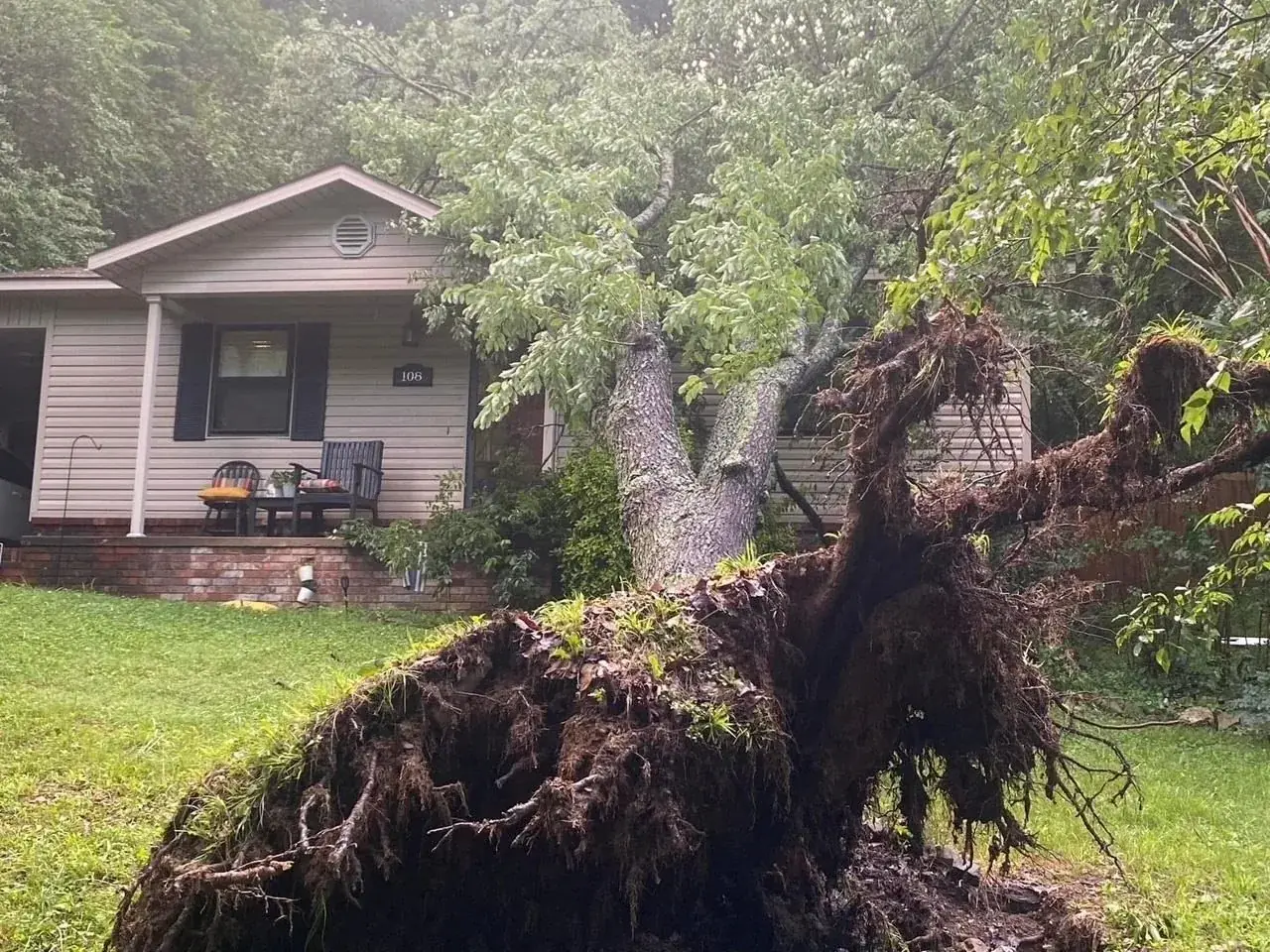
A bad storm rolls through overnight. You wake up and there’s a tree down in your yard — or worse, on your house, your fence, or across your driveway. The first instinct for most people is to walk outside and start figuring out what happened. That instinct can get you hurt.
In 24 years of tree work across Clark County and central Arkansas, we’ve responded to hundreds of storm calls. The situations that go wrong aren’t usually the tree removal itself — they’re what happens in the first hour after the tree comes down, before anyone professional arrives. People get hurt because they don’t know what to look for, or they move too fast before a dangerous situation is fully understood.
This guide walks you through exactly what to do after a tree comes down in Arkansas — in the right order, with the reasoning behind each step.
Step 1: Stay Inside and Assess Before You Go Out
Before you walk outside, take 60 seconds to look through a window and assess what you can see. Specifically, look for two things: downed power lines and a tree that hasn’t finished falling.
Downed power lines are the most immediate danger. A line that has been pulled down by a falling tree may still be energized. It doesn’t arc or spark constantly — it can sit on the ground looking completely harmless and still be live. If you see any line on the ground, on the tree, or draped across your yard near the fallen tree, stay inside, call 911, and call your utility company. Don’t go out until the utility company confirms the line has been de-energized. Don’t touch anything metal near the tree. Don’t walk through standing water in the yard if there are downed lines nearby.
The second thing to watch for is a tree that’s still in the process of falling. A tree that snapped at the trunk and is leaning against your house, another tree, or a fence is under massive stored tension. It can shift or drop suddenly without any additional wind or force. A tree that’s partially attached to the stump is especially unpredictable. Give it distance and time before going near it.
Also know that trees don’t always come down in one piece. When a trunk snaps, broken branches in the upper canopy that didn’t fall with the main trunk can hang for hours or days before coming down. Arborists call these widow makers for a reason. They can drop without warning, without wind, just from the gradual relaxation of the wood. Before you walk under any part of the tree canopy, look up.
Step 2: Document Everything Before Anything Is Moved
Once you’ve confirmed it’s safe to go outside, document the damage before anything is touched or moved. Take photos and video from multiple angles. Walk around the entire area — the fallen tree, any damage to structures, where the root ball came out of the ground, which direction the tree fell, and where it was originally rooted.
This documentation matters for two reasons. First, your insurance company will need it. A homeowner’s claim for tree damage to a structure requires evidence of the original damage — what the tree hit, how bad it was before cleanup began, and where the tree came from. Once a crew starts cutting and removing sections, the original scene is gone.
Second, if the tree came from a neighboring property, photos of where it was rooted can matter significantly if there’s a liability question. In Arkansas, you’re generally responsible for removing a neighbor’s tree that falls on your property — not the neighbor — unless there’s clear evidence the neighbor knew the tree was hazardous and failed to act. If you’ve had concerns about a neighbor’s tree, document those concerns in writing and photograph the tree before any storm season. That documentation becomes relevant if a failure occurs.
Don’t let anyone — including a tree service — start removing the tree before you’ve done your documentation. A legitimate company will wait the few minutes it takes. If a crew shows up and pressures you to start immediately before you can take photos, that’s a sign to slow down and reconsider.
Step 3: Call Your Homeowner’s Insurance
Once you’ve documented the scene, call your insurance agent before you call a tree service. Report the loss, get a claim number, and ask specifically what your policy covers and what your deductible is.
Most standard homeowner’s policies cover damage caused by a fallen tree to a structure — your house, garage, fence, deck, or other permanent structure on the property. What they typically don’t cover is the cost of removing a tree that fell in the yard without hitting anything. That removal cost usually comes out of pocket unless you have a specific endorsement for debris removal.
Having a claim number before you call a tree service is useful because many legitimate companies work directly with insurance adjusters and can document the job appropriately if they know a claim is in process. Some will even communicate directly with your adjuster to simplify the process. Get the claim number first — it takes five minutes and it matters.
One thing worth knowing: insurance companies may send their own adjuster to assess the damage before authorizing full payment. Don’t let anyone pressure you into completing the job before the adjuster has had a chance to see the original damage. Emergency tarping to prevent further water intrusion is usually fine and often covered — full removal before an adjuster visit can sometimes complicate a claim.
Step 4: Call a Local, Licensed Tree Service
After a major storm event in Arkansas, you will likely see crews you’ve never heard of going door to door within 24 to 48 hours. Some of these are out-of-state storm chasers who follow severe weather events looking for work. Some are legitimate. Many are not. This is one of the most consistent patterns we see after every significant storm season in this part of the state.
The risks with unknown crews are real. An uninsured crew member who gets injured on your property during removal can create a liability situation for you. A crew that doesn’t understand how a leaning tree is loaded can cause a controlled removal to become an uncontrolled one — bringing a section of tree down on your roof instead of away from it. A company that takes a large deposit and disappears before the work is done has no local accountability.
Work with a company you can verify locally. Check Google reviews. Ask a neighbor. Call the number and see if a real person picks up. Ask to see a certificate of insurance before any work starts — specifically general liability and workers’ compensation. These are two separate coverages and both matter. General liability covers damage to your property. Workers’ comp covers injuries to the crew on your job. If a company can’t produce both, move on.
A fallen tree on a structure is a more complex removal than a tree in an open yard. When a tree is resting on a building, its weight is distributed differently than when it’s on the ground. Cutting it without understanding the load distribution can cause sections to shift or drop unpredictably. This is technical work that requires experience with rigging, not just a chainsaw and a truck.
Step 5: Walk the Rest of Your Property Before the Next Storm
After the immediate situation is handled, take a walk around your entire property and look at the trees that are still standing. A storm that brought one tree down often damaged others that are still upright — and those standing trees sometimes represent a greater ongoing risk than the one that already fell, because people stop paying attention to them.
Look for large fresh cracks in trunks, splits at major branch unions, hanging broken limbs that didn’t fall, any new lean that wasn’t there before the storm, and bark damage from impact with other trees or debris. A tree that took a direct hit from another falling tree may have internal damage that isn’t visible from the outside. Lightning-struck trees, in particular, can look fine for a season and then decline rapidly. Check our guide on the signs a tree is dying if you’re not sure what to look for.
We do storm damage assessments at no charge for property owners throughout our service area. If you’ve had a storm come through and you’re uncertain about any trees on your property — standing or fallen — give us a call. We’d rather help you identify a problem before the next storm than respond to it after. We serve Arkadelphia, Glenwood, Malvern, Hot Springs, and the surrounding areas of Clark, Garland, and Hot Spring counties. We answer the phone.
Plyler’s Tree Service is a locally owned tree service company serving Arkadelphia, Glenwood, Malvern, Hot Springs, and the surrounding areas of Clark, Garland, and Hot Spring counties in Arkansas. We specialize in tree removal, tree trimming, stump grinding, and land clearing. 24 years of experience. Licensed and insured.