Stump Grinding vs Full Stump Removal: Which One Do You Actually Need?
You got a tree taken down — or one came down on its own — and now there’s an ugly stump sitting in your yard. The next question is always the same: do I grind it or have the whole thing pulled out?
After 24 years of handling stumps across Arkadelphia, Hot Springs, and every town in between, we can tell you that 95% of the time the answer is the same. But that other 5% matters, and choosing wrong can cost you money or tear up your yard for no reason. Here’s the honest breakdown.
What Stump Grinding Actually Does
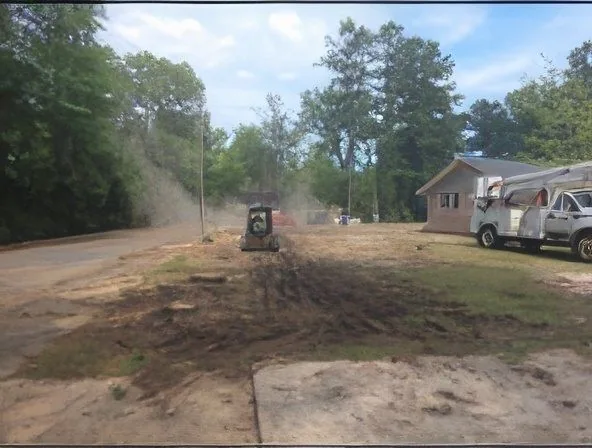
Stump grinding is exactly what it sounds like. We bring in a machine with a spinning carbide wheel and chew the stump down 6 to 8 inches below ground level. The whole thing turns into a pile of fine wood chips. We pack those chips into the hole, rake everything smooth, and when we leave you can grow grass right over the spot.
The roots stay in the ground. They’re not going anywhere — without the stump feeding them, they slowly decay on their own over the next few years. They won’t send up new shoots. They won’t cause problems. They just break down naturally underground.
The whole process takes about 30 minutes to an hour for most stumps. We can grind right next to fences, driveways, foundations, and sidewalks without tearing anything up. If you’ve got a yard full of old stumps — and a lot of folks around here do — we knock them all out in one visit.
What Full Stump Removal Involves
Full stump removal is a completely different job. Instead of grinding the stump down, we’re digging the entire thing out — stump, root ball, and all. That means bringing in heavier equipment, excavating a large hole around the stump, cutting through the major roots, and pulling the whole mass out of the ground.
What’s left is a big hole in your yard. We’re talking several feet deep and wide, depending on how big the tree was. That hole has to be filled with dirt, compacted, graded, and then you’re starting from scratch with topsoil and seed or sod. The surrounding yard takes a beating too — equipment tracks, displaced soil, damaged grass. It’s a much bigger disruption to your property.
So When Does Grinding Make Sense?
Almost always. If you’re a homeowner and you just want the stump gone so you can mow over it, plant grass, put in a flower bed, or just stop looking at it — grinding is the right call. It’s faster, it’s easier on your yard, and it gets the job done without tearing everything up.
Grinding makes sense when the stump is in your yard and you want a clean lawn, when it’s near your house or fence and you need precision, when you’ve got multiple stumps you want handled in one trip, when you’re tired of mowing around it or worried about termites finding it, and when you just want the eyesore gone without a major project.
That covers the vast majority of stumps we deal with in Clark County and the surrounding area.
When Is Full Removal the Better Option?
There are a few situations where you actually need the whole stump and roots out of the ground. They’re not common for most homeowners, but they’re real.
If you’re pouring a concrete foundation, building a patio, or putting up a structure exactly where the stump sits, the roots need to come out. You can’t pour concrete over a root system that’s going to decay and leave voids underneath. That’s how you get cracks and settling down the road.
If the root system is actively damaging your driveway, sidewalk, or foundation and you need to stop it — not just remove the visible stump — then full removal addresses the source of the problem.
If you’re doing a major landscaping overhaul and need the ground completely clear for regrading, full removal gives you a blank slate.
Outside of those situations, grinding handles it. And we’ll tell you that upfront when we come out to look at your stump. We don’t push the bigger job when the simpler one gets it done.
What About the Roots After Grinding?
This is the number one thing people ask, and it makes sense — you can’t see what’s happening underground. Here’s the truth: once the stump is ground below grade, the root system has no energy source. It can’t photosynthesize. It can’t send up new growth. The roots sit underground and slowly decompose over the next several years. They soften, break down, and become part of the soil.
You won’t see new shoots popping up. You won’t have roots suddenly heaving your sidewalk. The underground decay process is slow and harmless. In over two decades of grinding stumps around Arkadelphia and Hot Springs, we’ve never had a customer call back with a root problem after grinding.
Which One Do Most People Choose?
Grinding. It’s not even close. Out of every 20 stump jobs we do, maybe one involves full removal — and that’s usually because someone is building something on that exact spot. The rest are all grinds.
Most homeowners just want a clean yard. They want to stop mowing around the stump, stop worrying about termites, and stop looking at the thing every time they pull into the driveway. Grinding handles all of that in under an hour with zero damage to the rest of your property.
Not Sure Which One You Need?
Robbie has been looking at stumps for 24 years across Arkadelphia, Hot Springs, and every town within 40 miles. He’ll come out, look at your stump, and tell you straight — grind it or pull it. No charge for the estimate, no pressure to say yes. Get your free estimate. And if there’s still a whole tree to bring down first, here’s what tree removal costs in Arkansas.