5 Signs a Tree Is Dying and Needs to Come Down
A dying tree doesn’t always fall over and make it obvious. Most of the time, it gives you warning signs for months — even years — before it becomes dangerous. The problem is, most homeowners don’t know what to look for until a limb lands on a roof or a car.
After 24 years of tree work in Clark County and the surrounding areas, we’ve seen what happens when people wait too long. A tree that could have been removed cleanly for a reasonable price turns into an emergency job that costs two or three times as much — and puts people at risk in the process.
Here are 5 signs your tree may be dying and what to do about each one.
1. Dead Branches That Don’t Leaf Out in Spring
Every spring, healthy trees push out new leaves. If a large section of your tree — especially in the upper canopy — stays bare while the rest of the tree leafs out, those branches are dead.
One or two small dead branches isn’t necessarily a crisis. Trees shed dead wood all the time as a normal part of growing. But if a major limb or a significant portion of the canopy fails to leaf out, the tree has a serious problem. It could be a root issue, a disease, or pest damage that’s cut off the water supply to that section of the tree.
Dead branches don’t stay attached forever. They dry out, get brittle, and fall — often without any warning and without needing wind or a storm to bring them down. If dead branches hang over a house, driveway, or anywhere people walk, they need to come off. Trimming out dead branches is sometimes all a tree needs. Other times, it’s the first sign the whole tree needs to come down.
2. Bark That’s Falling Off or Has Large Bare Patches
Healthy tree bark is tight to the trunk. It might be rough or deeply furrowed depending on the species, but it stays attached. When bark starts falling off in large sections and leaves smooth, bare wood underneath, that’s called canker disease — and it’s a sign the tree is in serious decline.
You might also notice discolored patches, sunken areas, or cracks in the bark. These are often entry points where fungus or bacteria got in, usually after a wound from a storm, a lawn mower, or improper pruning. Once a canker establishes itself on a large portion of the trunk, the tree usually can’t recover.
Bare patches near the base of the tree are especially concerning. The base of the trunk carries all the water and nutrients between the roots and the canopy. Damage there compromises the entire tree, not just one section.
3. Fungus or Mushrooms Growing at the Base
Mushrooms growing at the base of a tree or from the roots are one of the clearest signs of internal rot. The mushrooms you see on the outside are just the fruiting bodies — the actual fungal growth is deep inside the wood, breaking down the cellulose that gives the tree its structural strength.
A tree can look perfectly healthy from the outside while being hollow or severely rotted on the inside. This is what makes fungal growth so dangerous. The tree may stand for another year or two, but when a storm hits, it doesn’t bend — it snaps or uproots without warning.
If you see shelf fungus (also called bracket fungus) growing on the trunk or root flare, call an arborist. This is not something to watch and wait on. It means the wood is already compromised and removal is likely the safest option.
4. Leaning That Wasn’t There Before
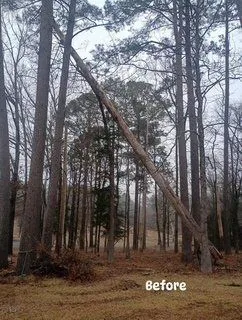
Some trees grow at an angle — that’s normal and not a concern. What’s not normal is a tree that suddenly starts leaning when it was straight before, or a lean that gets more pronounced over a short period of time.
Sudden lean usually means one of two things: root failure or trunk damage. Roots on one side may have rotted or been cut by construction or digging. The trunk may have cracked or split internally without it being visible from the outside. Either way, a tree that’s actively leaning is under structural stress and is significantly more likely to fall.
Pay attention to the ground around the base. If you see soil heaving or cracking on the opposite side from the lean, the root system is already lifting. That tree is in the process of failing. Don’t park under it, don’t let kids play near it, and call us.
5. The Tree Has Been Struck by Lightning or Severely Storm Damaged
Arkansas gets its share of severe storms, and lightning strikes are more common than most people realize. A tree that takes a direct lightning strike often looks okay for a season or two before the damage shows up fully. Lightning travels down through the tree’s vascular system, cooking the tissue inside. The tree may push out leaves the following spring and look fine — and then die suddenly.
Storm damage that splits major limbs or cracks the trunk creates entry points for disease and pests that move fast in the Arkansas climate. A tree that lost a large limb in a storm should be evaluated, not just cleaned up and forgotten.
If your tree took significant storm damage, have someone look at it before the next storm season. What looks like cosmetic damage from the outside is often the beginning of a decline that ends in a failure at the worst possible time.
What to Do If You See These Signs
The short answer is: don’t wait. A tree that’s showing multiple signs of decline isn’t going to recover on its own. Every season you wait, the wood gets weaker, the removal gets more complicated, and the risk of an unplanned failure goes up. A dead tree in Arkadelphia only gets more dangerous and more expensive to remove the longer it stands.
If you’re not sure whether a tree needs to come down or just needs some work, that’s exactly what we’re here to figure out. Sometimes a tree just needs dead wood removed and it can stay for years. Other times, removal is the only safe option — and the sooner it happens, the cleaner and less expensive the job is. See our guide on when to trim vs when to remove if you want more detail on how that decision gets made. If you’re wondering what removal runs, here’s what tree removal costs in Arkansas.
We serve Arkadelphia, Glenwood, Malvern, and the surrounding Clark County area. Call us and we’ll come take a look — no charge for the assessment.
Plyler’s Tree Service is a locally owned tree service company serving Arkadelphia, Glenwood, Malvern, and Clark County, Arkansas. We specialize in tree removal, tree trimming, stump grinding, and land clearing. 24 years of experience. Licensed and insured.