Is My Tree Too Close to My House? What Arkansas Homeowners Should Know
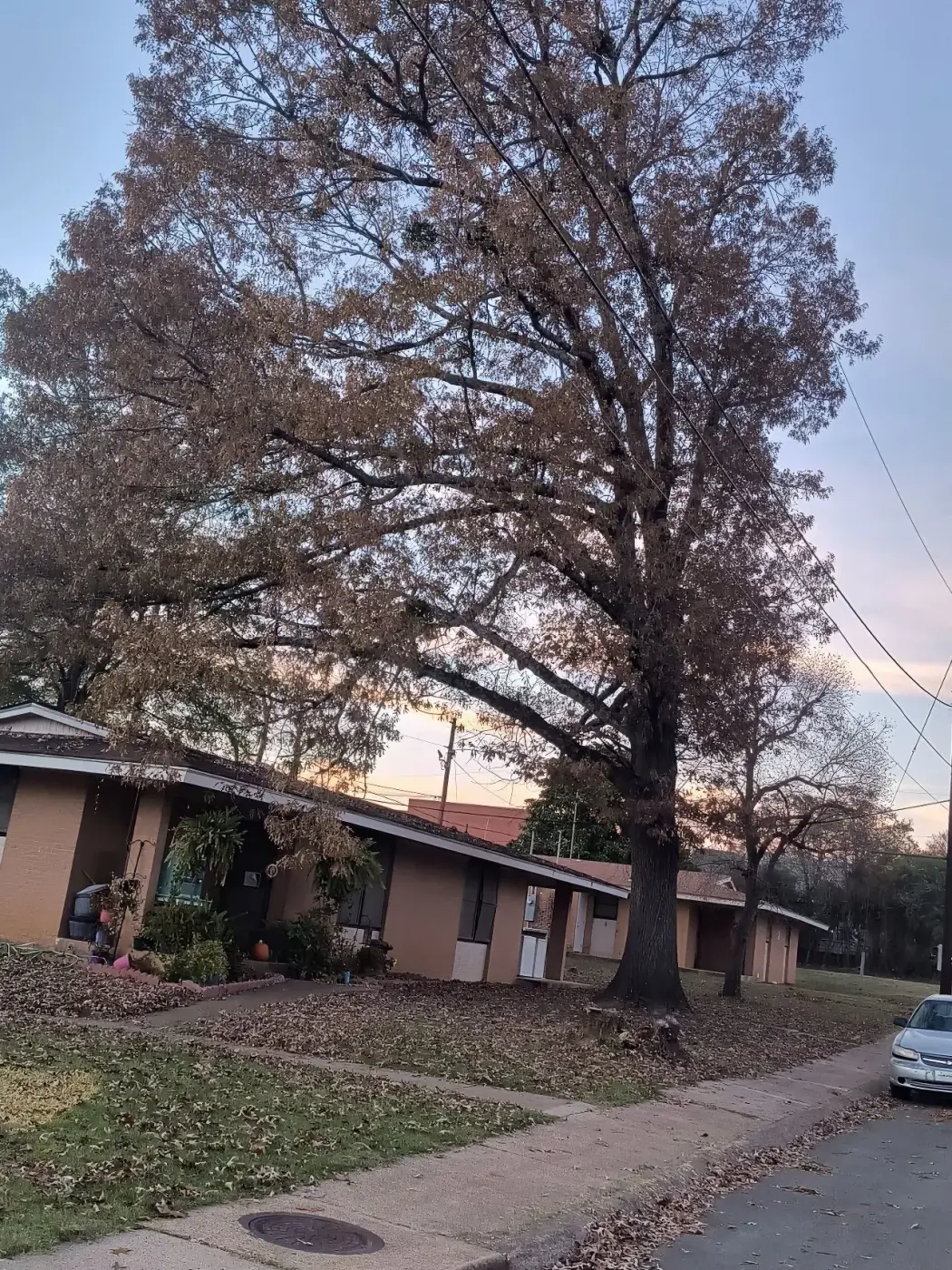
If you have a large tree growing near your house, at some point you’ve probably stood outside and wondered whether it’s too close. Maybe a limb is hanging over the roof. Maybe the roots are starting to show up near the foundation. Maybe you just bought the property and you’re not sure what you inherited.
It’s one of the most common questions we hear from homeowners in Arkadelphia, Glenwood, and across Clark County. And the honest answer is: it depends on the tree, the species, how old it is, and what’s around it. There’s no single number that applies to every situation. But there are clear warning signs, practical guidelines, and a decision framework that helps you figure out whether you’re dealing with a manageable situation or a real risk.
After 24 years of tree work in central Arkansas, we’ve seen both. This guide covers everything you need to know to make that call — or to know when to call us.
The General Distance Guidelines by Tree Size
Most arborists and builders use a rough size-based guideline when it comes to how close a tree should be planted — or allowed to grow — near a structure. These aren’t hard rules, but they give you a useful starting framework.
Small trees — under 25 feet at full maturity, like dogwoods, redbuds, or most ornamental trees — should be at least 6 feet from the foundation. These trees have shallow, limited root systems and relatively small canopies. At 6 feet, there’s enough buffer to prevent root pressure on the foundation and to keep branches from constantly rubbing the roofline.
Medium trees — 25 to 50 feet at maturity, including most fruit trees and smaller oaks — should be at least 15 feet from the foundation. These trees develop more significant root systems that can extend well beyond the drip line, and their canopies can drop large limbs in a storm if they’re close to the structure.
Large trees — anything over 50 feet at maturity — should ideally be 20 to 30 feet from the foundation, and farther if possible. In Clark County and across central Arkansas, the large native species — water oaks, willow oaks, sweetgum, loblolly pine, and pecan — are the ones that cause the most problems when they’re planted or left to grow too close to homes. These trees get big fast, and their root systems extend well beyond what most homeowners expect.
If you already have a large tree closer than these guidelines, that doesn’t automatically mean it needs to come down. It means you need to look more carefully at what’s actually happening between the tree and your house.
What Roots Actually Do to Your Foundation and Yard
Most homeowners focus on the branches when they think about tree risk — and that makes sense, because a branch coming through a window or a roof is dramatic and immediate. But roots are often the slower, costlier problem. And because root damage develops over years, it’s easy to miss until it’s already significant.
Tree roots generally extend outward to a distance roughly equal to the height of the tree — sometimes more. A 60-foot water oak standing 20 feet from your house very likely has roots reaching under your foundation, your driveway, and possibly your sewer lines. Those roots grow every year. They follow water. They follow the path of least resistance. And once they’re under your slab or wrapped around a pipe, removing them without removing the tree doesn’t solve the problem permanently.
Foundation damage from tree roots shows up slowly. You might notice hairline cracks in the slab or brick. Doors and windows that used to close cleanly start sticking. Floor tiles begin to separate. These aren’t always caused by roots — settlement and soil movement can do the same thing — but if a large tree is within 30 feet of your foundation and your house is showing any of those signs, the tree is worth evaluating before you spend money on foundation repair.
Sewer line damage is another common issue we encounter in this area. Older homes in Arkadelphia and Glenwood often have clay sewer pipes with joints that roots find easily. A tree between your house and the street that’s over 30 years old may have roots in your sewer line right now. If you’re having repeated backups and a slow drain that doesn’t respond to normal clearing, that’s worth investigating before the next big rain.
Driveway damage is more visible but often dismissed as normal wear. If you have large cracks or sections of your concrete driveway heaving upward in a pattern that traces back toward a nearby tree, that’s roots. Patching the driveway without addressing the tree is a temporary fix at best.
When Branches Are the Main Concern
Sometimes the root system isn’t the issue — the concern is branches overhanging the roof, rubbing the house, or hanging over power lines. This is a different problem with a different solution.
Branches that overhang the roof create several issues even when the tree is healthy. Leaves and debris accumulate in gutters and on the roof, which accelerates shingle deterioration and can lead to moisture problems over time. Squirrels and other animals use overhanging branches as a bridge onto the roof and into the attic. And in a storm, a branch that’s directly over the house has nowhere to go but through it.
If the concern is overhang and the tree itself is structurally sound and healthy, trimming is usually the right answer. A proper crown reduction or canopy lift can eliminate the overhang risk without removing the tree. See our guide on trimming vs removal for a full breakdown of how that decision gets made and what good pruning actually looks like.
Trimming won’t solve a root problem. If roots are already under the foundation or in the sewer line, removing surface roots or pruning the canopy doesn’t stop the underground growth. The tree continues producing roots whether the top has been trimmed or not. In those cases, removal is usually the only real fix.
Trees Near Power Lines: A Separate Issue
If a tree on your property is growing into overhead power lines, you’re dealing with a situation that involves both safety risk and a second party — your utility company. In Arkansas, utility companies have the legal right to trim trees that interfere with their lines, and they will exercise that right on their schedule, not yours.
The problem is that utility trimming is done for line clearance, not for the health or structure of the tree. You may end up with a severely topped tree — one where large sections of the crown have been removed — that is now structurally compromised. A heavily topped tree is more likely to fail in a storm because the cuts create large wounds that decay, and the regrowth that follows is often weakly attached to the trunk.
If you have a tree growing toward power lines, the better approach is to address it proactively with a professional trim or removal before the utility company does it for you. We can work around lines and coordinate with the utility company when necessary. The result is usually a healthier, safer outcome for the tree and the property.
The Dying or Damaged Tree Near the House: Highest Risk Scenario
A healthy tree 15 feet from your house is one kind of situation. A dying or structurally compromised tree 15 feet from your house is a fundamentally different risk. The proximity matters, but so does the condition of the tree.
When a tree is both close to a structure and showing signs of decline — dead branches, fungal growth at the base, sudden leaning, bark falling off in large sections — the combination of those two factors creates a high-priority situation. A declining tree doesn’t fail on a predictable schedule. It can stand through several storm seasons and then come down on a calm day, or it can fail at the worst possible moment in the middle of a severe storm.
See our full guide on the signs a tree is dying if you’re not sure whether what you’re seeing is normal or a warning. When a declining tree is close to a house, the standard advice is not to wait and see — it’s to get someone to look at it and make a call.
What We Look at When We Come Out for an Assessment
When we assess a tree near a structure, we’re looking at several things simultaneously: the species and its typical root behavior, the approximate age and size, the distance from the foundation and any underground utilities, visible signs of structural weakness or disease, the condition of the soil and any signs of root heave, and what the tree would likely hit if it failed in a specific direction.
That last point matters more than most people realize. A tree that would fall away from the house in a failure is a lower risk than one that would fall directly onto the roof or toward a neighboring structure. The direction of lean, the weight distribution of the canopy, and the prevailing wind patterns in your yard all factor into how we think about risk.
We do these assessments at no charge for property owners in our service area. We’ll tell you straight what we see — whether the tree is fine, whether it needs trimming to reduce risk, or whether removal is the safer choice. We don’t tell homeowners a tree needs to come down if it doesn’t. Twenty-four years in this business means our reputation is worth more than an unnecessary job.
We serve Arkadelphia, Glenwood, Malvern, Hot Springs, and the surrounding areas of Clark, Garland, and Hot Spring counties. Give us a call and we’ll come take a look.
Plyler’s Tree Service is a locally owned tree service company serving Arkadelphia, Glenwood, Malvern, Hot Springs, and the surrounding areas of Clark, Garland, and Hot Spring counties in Arkansas. We specialize in tree removal, tree trimming, stump grinding, and land clearing. 24 years of experience. Licensed and insured.