
What to Plant After a Tree Comes Down: Best and Worst Trees for South Arkansas Yards
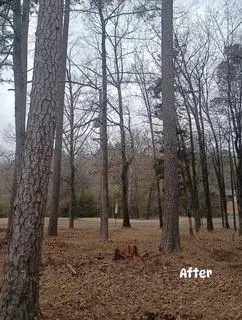
Half the time, after we finish a removal and the yard is raked clean, the homeowner looks at the empty spot and asks the same question: “What should I put back?”
I love that question. I spend most of my year taking trees down, and a lot of what I remove are trees that should never have been planted where they were. Wrong tree, wrong spot, forty years later it’s a crane job over somebody’s kitchen. After 24 years of removals across Clark County, I have strong opinions about what belongs in a south Arkansas yard, so here they are.
First, Deal With the Stump
If you want to plant in the same spot, say so before the stump grinding happens. A standard grind goes a few inches below grade, which is fine for grass but not for a new tree. Replanting in the same hole needs a deeper grind to clear the old root mass, and it’s easy to do while the machine is already there. Even then, the smart move is planting a few feet off the old spot, where the new roots aren’t fighting decades of old wood. More on that in my grinding vs. removal guide.
Trees I’d Put in My Own Yard
Nuttall oak. If you want one recommendation, this is it. A true south Arkansas native that handles our clay, our wet winters, and our dry summers, grows faster than most oaks, and turns a real red in fall. It’s the oak I tell people to plant when they’ve lost one.
Willow oak. The classic Southern shade tree, fast for an oak, with fine leaves that don’t smother a lawn. Give it room, because it gets big.
Bald cypress. Bulletproof in wet spots and around the lake, handles drought better than people expect, and ice slides off its winter-bare branches. For DeGray-area and low-ground lots, it’s hard to beat.
Black gum. Tough, native, well-behaved roots, and the best fall color in the state. Slower growing, which is exactly why it’s strong.
Red maple. The honest fast-growing choice. Quicker shade than an oak without the weak wood of the trees on my other list below. Pick an improved variety and give it water its first two summers.
Trees I Take Down for a Living
These are the trees that keep me in business, and I mean that as a warning:
Bradford pear. The worst offender. That tight V-shaped branching splits apart under ice and wind almost on a schedule, usually between year fifteen and twenty-five. I remove split Bradfords every single year, and the state of Arkansas has been actively encouraging people to replace them. Plant a serviceberry or a dogwood instead if you want the spring white.
Silver maple. Fast shade with a hidden bill. Weak, brittle wood that drops limbs in every storm, and shallow roots that hunt sewer lines and heave driveways.
Leyland cypress. Sold everywhere as a quick privacy screen, and for a while it is. Then disease and ice find it, and you’re removing a dead brown wall thirty feet tall. There are better screens.
Sweetgum, near anything. A fine tree in the woods, but plant one over a patio and you’ll be raking spiked balls off everything for fifty years. Its roots also break up whatever they run under.
Anything fast-growing right next to the house. Fast wood is weak wood, as a rule. The tree that shades your porch in five years is the tree hanging over your bedroom in twenty.
How Far From the House?
The mistake I undo most often is planting too close. That little five-foot sapling looks lonely out in the yard, so people tuck it near the porch, and twenty years later I’m quoting a sectional removal over the roof.
The rule I give: a big shade tree, anything that matures over 50 feet, belongs at least 20 feet from the house, and 30 is better. Medium trees like red maples and black gums want 15 feet or more. Small ornamentals, your dogwoods and redbuds, can live within 10 feet without causing trouble. If you’re staring at a tree that’s already too close and wondering how bad it is, I wrote a whole guide on when a tree is too close to the house.
Plant with the mature tree in mind, not the sapling in your hand. Your future self, and honestly my future crew, will thank you.
When to Plant in Arkansas
Fall. October through early December is planting season here, not spring. A fall-planted tree spends the winter growing roots and hits its first Arkansas summer established, while a spring-planted one meets July half ready. Second best is late winter. The worst time is exactly when the garden centers are busiest.
About Plyler’s Tree Service
Plyler’s Tree Service has served Arkadelphia and Clark County since 2002. Owner Robbie Plyler and his crew handle tree removal, trimming, stump grinding, and emergency storm work across Clark, Hot Spring, Garland, and Pike counties. Fully insured, with over 70 five-star Google reviews.
Need a tree handled? Get a free estimate today.
Call (870) 245-7944 or request a free quote. We’ll clear the old one and tell you what belongs in its place.